Beekeeping practice
Bee syrup ratios: 6 kg of feed is not 6 kg of sugar
Your notebook says “fed 6 kg”. Six kilograms of what: dry sugar, finished syrup, or a ready-made product? With a 2:1 mixture by weight, a 6 kg batch contains just 4 kg of sugar. That small distinction changes your shopping list, your mixing plan and what you can learn from last year's feeding records.
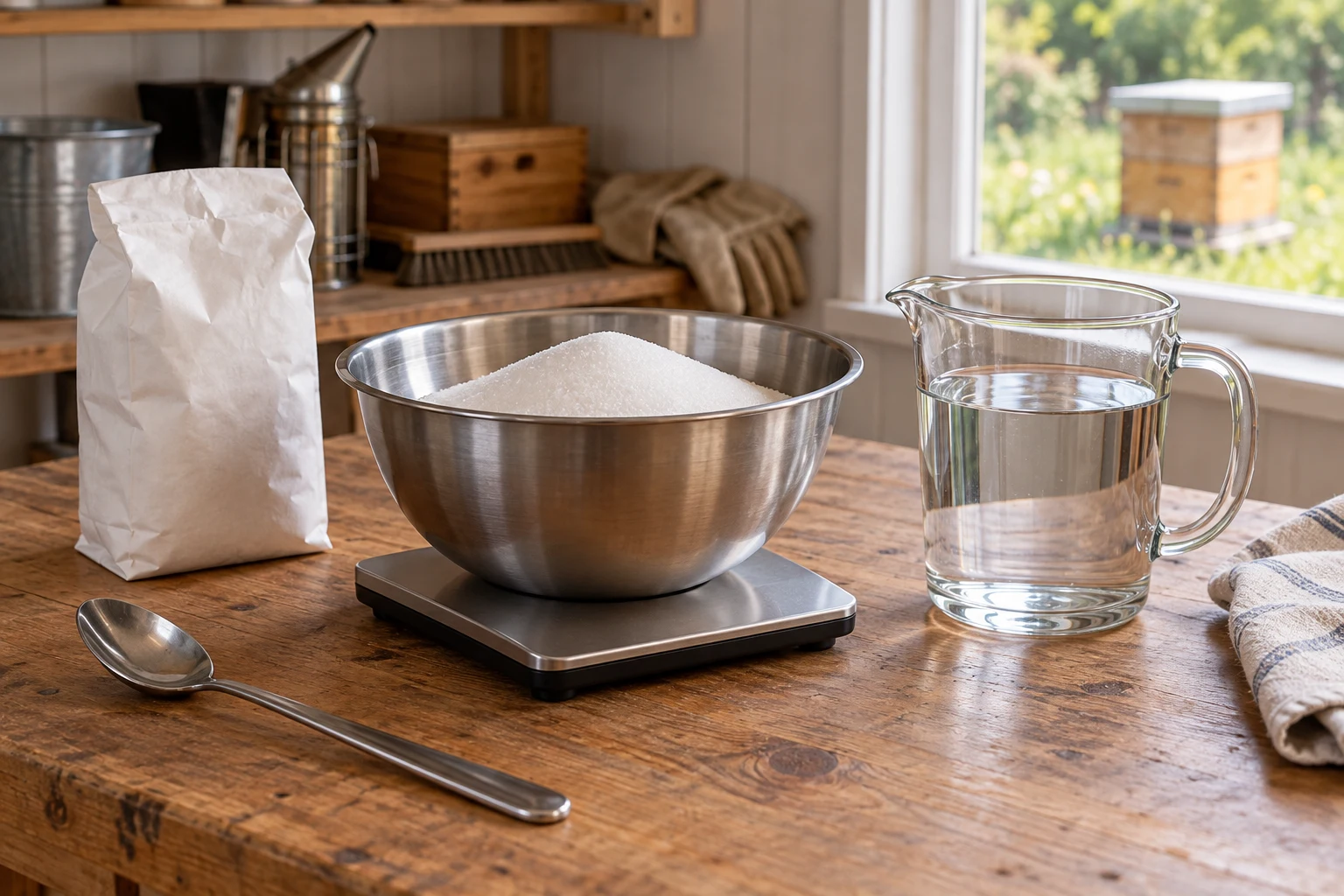
First, give the ratio its units
In this guide, every ratio means sugar : water by weight. Alabama Cooperative Extension defines heavy syrup as two parts sugar to one part water by weight. The same arithmetic works in kilograms or pounds, provided you use the same unit for both ingredients.
For a ratio of 2:1, there are three parts in total. Two belong to sugar; one belongs to water. The sugar therefore makes up two-thirds of the starting batch weight. A 1:1 mix contains equal weights, while 3:2 contains three parts sugar and two parts water.
- 1:1 — a 6 kg batch uses 3 kg sugar and 3 kg water (50% sugar by weight).
- 3:2 — a 6 kg batch uses 3.6 kg sugar and 2.4 kg water (60% sugar by weight).
- 2:1 — a 6 kg batch uses 4 kg sugar and 2 kg water (about 66.7% sugar by weight).
Are you starting with a batch size or a bag of sugar?
These are different questions. Suppose you want 12 kg of finished 2:1 syrup. Divide 12 by the three total parts: each part weighs 4 kg. You need 8 kg of sugar and 4 kg of water.
Now suppose you already have 6 kg of sugar and want to use all of it. At 2:1, the water must weigh half as much: 3 kg. Your batch will weigh 9 kg, before any losses. Entering that same 6 kg as the total batch would produce a different recipe.
For any sugar-to-water ratio a:b, multiply the desired batch weight by a/(a+b) for sugar and b/(a+b) for water. Starting with sugar instead? Multiply its weight by b/a to find the water to add. Check your result by adding the ingredient weights.
Why a pound-to-pint recipe gives a different answer
A recipe using weight for sugar and volume for water is not a weight-to-weight ratio. Wally Shaw's Feeding Bees, published by the Welsh Beekeepers' Association, gives an autumn mix of 1 kg sugar dissolved in 625 ml water, alongside the traditional two-pounds-to-one-pint description.
Using approximately 1 kg per litre for water, that recipe is about 1.6:1 by weight, rather than 2:1. This is our arithmetic comparison of the stated quantities, not a correction to that recipe or a claim that one concentration suits every colony.
When comparing instructions, copy the actual quantities and units. Do not turn “two pounds and one pint” into “two kilograms and one kilogram” and assume you have preserved the mix. Follow your chosen local guidance consistently.
Weigh the ingredients; leave room in the bucket
Kilograms describe mass. Litres describe volume. Adding ingredient weights gives the batch weight, but adding water litres to sugar kilograms cannot give the finished syrup volume. A container marked 6 litres is not a scale marked 6 kg.
Use a scale with sufficient capacity. Account for the container by taring it, and measure the water and sugar separately if the whole batch would exceed the scale's limit. Choose a mixing vessel with room for stirring, rather than filling it to the rim.
Use plain white granulated sugar and clean equipment. Dissolve the sugar fully in warm water; do not boil the sugar-and-water mixture. These preparation points follow the extension and WBKA guidance linked below. Let the feed cool before putting it into a suitable feeder.
A mixing calculation cannot assess a colony
An equal division is useful for carrying supplies. For example, 9 kg of 2:1 syrup divided among three hives is 3 kg of syrup per hive, containing 2 kg of sugar each. That is an arithmetic example, not a feeding target for three real colonies.
Cornell's overwintering guidance for cold-winter conditions in New York stresses assessing existing stores and acting while bees can still process liquid feed. Its dates and hive-weight targets belong to that setting; they are not a September prescription for every reader.
Choose the feed and amount from the colony's condition, accessible stores, local forage, weather and regional advice. Keep sugar feeding separate from honey intended for harvest. A correct ratio does not make an unsuitable feeding decision correct.
Write a note you can still interpret next spring
Distinguish the batch you prepared from the amount actually supplied to each hive. A useful example is: “18 September — Hive 4 — supplied 3 kg finished white-sugar syrup, 2:1 by weight; equivalent to 2 kg dry sugar. Reason: stores assessed as low at today's check. Recheck uptake and stores at the next suitable visit.” This is an illustrative record, not a report from an ApiNote customer.
Record leftovers and later observations separately. Feed supplied is not a measurement of food subsequently stored in the combs. Keeping those observations distinct makes comparisons between colonies more useful.
ApiNote's free sugar syrup calculator supports both total-batch and sugar-available calculations for 1:1, 3:2 and 2:1 mixtures in kilograms or pounds. The direct link is in the resources below. Its results stay on the web page; record the actual feeding with the hive in ApiNote, including the date, feed type, amount and a note explaining the units.
Sources & further reading
- Alabama Cooperative Extension — Supplemental Feeding for Honey Bees (weight ratios and preparation)
- Welsh Beekeepers’ Association — Wally Shaw, Feeding Bees, Appendix 1 (mixing quantities and method)
- Cornell University — Overwintering (regional context for stores and timing)
- ApiNote — Free sugar syrup calculator
ApiNote · iOS & Android
Good notes make the next visit easier.
Give every colony a history you can find again. ApiNote is available for iOS and Android, free for up to five hives.
Compare Free & ProKeep exploring
Preparing bees for winter: a colony-by-colony checklist
Review stores, colony condition, varroa follow-up and hive protection before winter. A practical checklist that avoids one-size-fits-all dates and feed targets.
Updated
Spring feeding: assess stores before adding supplements
When do bees need spring feed or protein supplements? Start with stores, pollen availability and colony demand, then record and reassess what you provide.
Updated
What to record in a beekeeping logbook
A practical hive record checklist: inspections, queens, feeding, treatments, mite counts and harvests, with clear next actions for your next apiary visit.
Updated